Blog · · Wersja polska
Gettysburg: Has Everything Already Been Written About This Battle? A Subjective Reading Guide
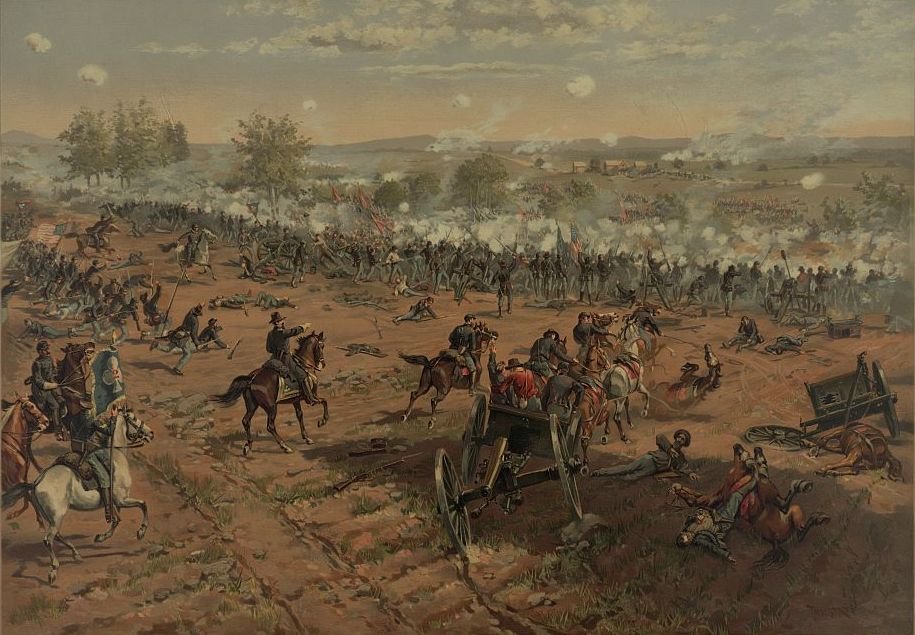
Leaving aside the standard monographs and microhistories, there are books about the horses, the presidential address, the monuments – and even the paranormal.
While tidying my shelves (a necessity brought on by compulsive buying of new titles…), I went through my “Gettysburg library”, both paper and e-books. Here is a subjective guide to what is worth reading, based on the slice of the literature I have come across.
It is best to start with a comprehensive, single-volume account of the whole campaign.
I have three candidates in this category:
- Noah Andre Trudeau, “Gettysburg: A Testing of Courage”;
- Stephen Sears, “Gettysburg”;
- and Allen Guelzo, “Gettysburg: The Last Invasion”.
Each is written in an accessible, fluent style, and each places its emphasis slightly differently.
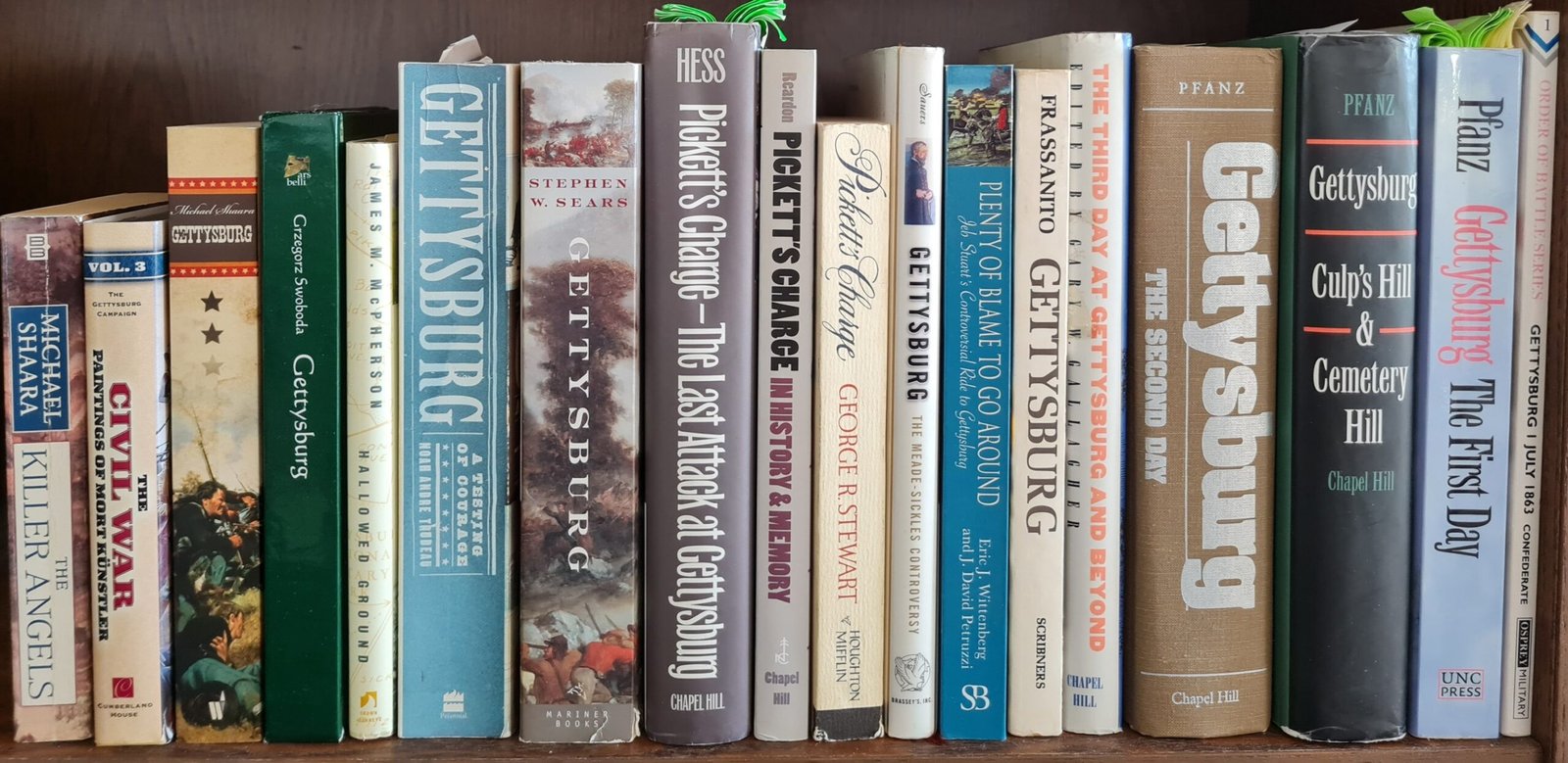
Trudeau’s work is well organised in a chronological sequence of events and full of eyewitness accounts, but for me Sears’s narrative flows better. If I had to pick just one of the three, though, I would choose Allen Guelzo’s The Last Invasion. Not only is it the most recent, but the author repeatedly relates the commanders’ decisions and tactical solutions to the theory and drill manuals of the period. Reading Civil War battle studies by American authors, one sometimes gets the impression that while they did truly painstaking work with the sources, they avoided exactly this kind of inquiry like the plague. Guelzo also sketches the political side and the wider background of the campaign very skilfully. The same is true of Sears’s book, while Trudeau concentrates more on the battle itself.
For readers who prefer Polish, there is still Grzegorz Swoboda’s “Gettysburg” – ideally its latest, expanded edition (Attyka, 2010). In terms of its source base it cannot be compared with the books above, but I have a great fondness for it. Despite all its shortcomings, Swoboda’s light touch can still draw even a reader completely unfamiliar with the Civil War into the story of the battle – and perhaps, if it is their first book on the events of 1861–1865, into the whole war.
No such list would be complete without the work regarded as fundamental: Edwin Coddington’s “The Gettysburg Campaign: A Study in Command” (1968). I will refrain from giving an opinion, however, because – I am ashamed to admit – to this day I have read only parts of it.
The same goes for Glenn Tucker’s “High Tide at Gettysburg”. The latter is important because it strongly influenced the author of the most widely read novel about the battle (Michael Shaara’s “The Killer Angels”, more on which below), and therefore the famous film and the whole popular image of Gettysburg. Clifford Dowdey’s “Lee and His Men at Gettysburg: The Death of a Nation”, on the other hand, has certainly aged much worse than Coddington’s work – partly because of its one-sided approach.
Tactical studies
With one of the volumes above as a foundation, you can dive into the deeper waters of detailed tactical history. In this category I recommend three volumes by Harry W. Pfanz: “Gettysburg: The First Day”, “Gettysburg: The Second Day” and “Gettysburg: Culp’s Hill and Cemetery Hill”. Pfanz avoids the typical trap of such studies – he never loses sight of the forest for the many trees. He goes down to the level of regiments and even companies, but these descriptions always serve the wider picture of the actions of brigades, divisions and corps. The narrative lens zooms in and out, yet it is never art for art’s sake or an excuse to pour out soldiers’ letters and memoirs. The text is complemented by numerous excellent maps, without which following fighting described in such detail would simply be impossible. Editorially, the books maintain the high standard readers expect from the University of North Carolina Press.
Pickett’s Charge
Pfanz covered the first and second days of the battle and, for the northern part of the field, the third day as well. What remains is the climax: Pickett’s Charge. George Stewart’s “Pickett’s Charge: A Microhistory of the Final Attack at Gettysburg, July 3, 1863”, published back in 1959, still holds up – not least thanks to its superb style. It is worth reading it first and then turning to the more recent (2001) study by Earl J. Hess, “Pickett’s Charge: The Last Attack at Gettysburg”. Stewart’s work was pioneering in many respects, but Hess’s book can be regarded as the last word (for now) on the tactical analysis of the assault. As a bonus – Carol Reardon, “Pickett’s Charge in History and Memory”. It is a truism, but showing how the perception and portrayal of the attack changed on the two very different planes of history and memory matters a great deal, especially for an event so overgrown with myth.
Controversies
Richard Sauers’s “Gettysburg: The Meade-Sickles Controversy” is a very solid piece of work that convincingly dispels the myths surrounding the events of the second day. It is concise and to the point – no unnecessary digressions, though also a little lacking in flair. The essay collection “The Third Day at Gettysburg and Beyond”, as usual for this series (Military Campaigns of the Civil War, again from UNC Press), contains a wide variety of material: truly Plutarchian “parallel lives” of Armistead and Garnett, a view from the ranks of a sergeant of the 14th Connecticut, and a topic that genuinely goes beyond the battlefield – the controversy over Meade’s so-called pursuit.
If that is not enough, there is a whole book on the subject – Kent Masterson Brown, “Retreat from Gettysburg: Lee, Logistics, and the Pennsylvania Campaign”. For fans of cavalry-raid controversies, David Petruzzi (in “Plenty of Blame to Go Around: Jeb Stuart’s Controversial Ride to Gettysburg”) examines the little odyssey of the Confederate cavalry and its unfortunate consequences for the Army of Northern Virginia. Finally, James M. McPherson’s essay, in which a short account of the battle is interwoven with reflections from walks across the battlefield (“Hallowed Ground: A Walk at Gettysburg”), is probably a good choice for anyone who wants a concise picture of the event.
Paintings and photographs
A few titles will help us visualise the events described.
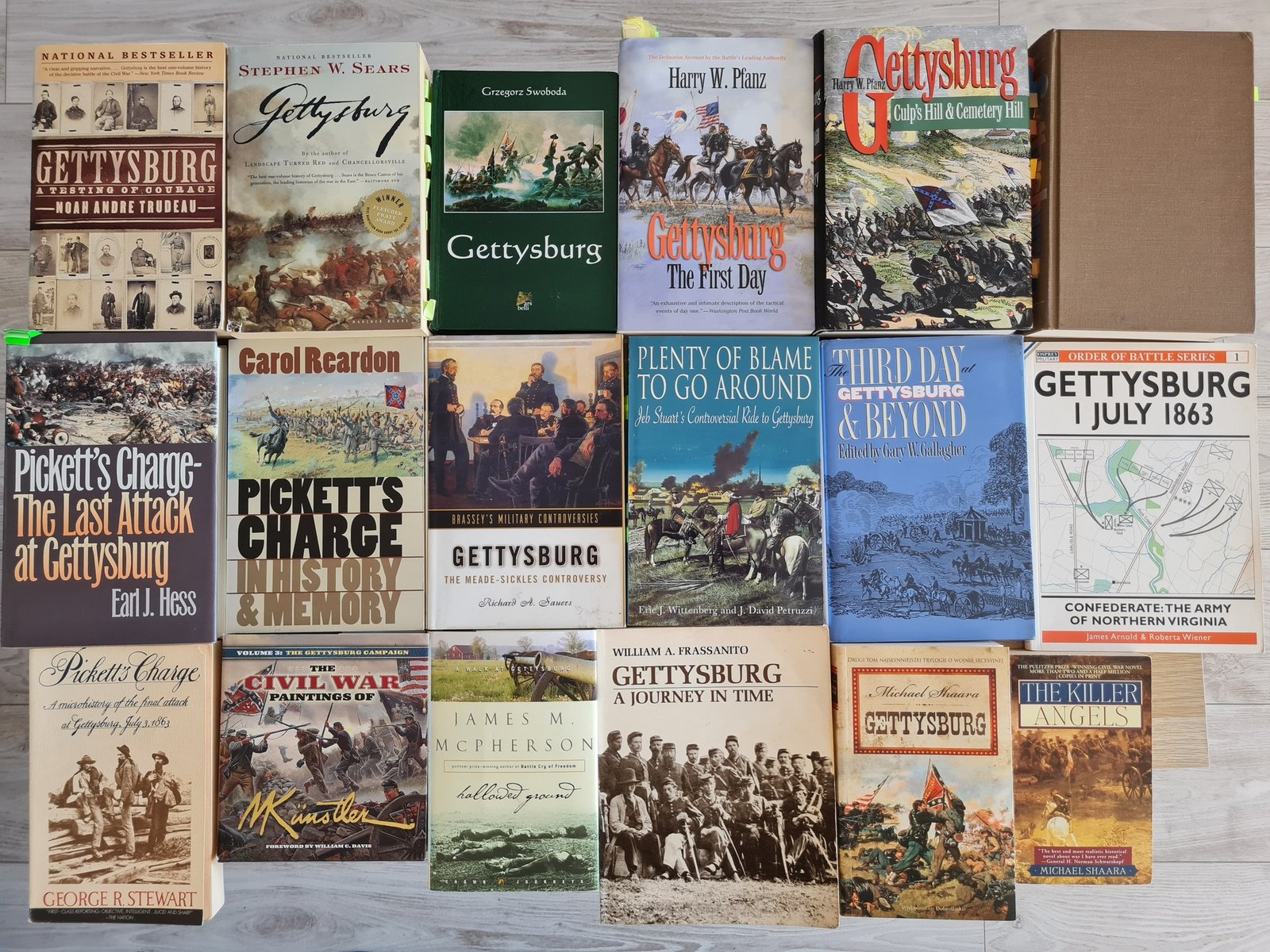
Reproductions of most of the 36 paintings by Don Troiani found in his Gettysburg album have already appeared in earlier publications by this outstanding artist and uniform expert. While recommending all of them, I would also point to “The Civil War Paintings of Mort Künstler, Vol. 3: The Gettysburg Campaign”. It is an interesting volume because anyone who has watched the film “Gettysburg” (not necessarily dozens of times) will recognise its illustrations. William A. Frassanito, known for his excellent photographic study of the Sharpsburg battlefield, is the author of “Gettysburg: A Journey in Time”. The formula of both books is similar: Frassanito analyses photographs of successive parts of the battlefield and, since he knows them like the back of his hand, discovers a great deal in the most unexpected places. It is also worth reading so as not to forget that a battlefield in the middle of summer had little in common with a bucolic idyll.
My Gettysburg “shelf of shame” (including a virtual, e-book one) is another story.
I will only add that my list of potentially interesting reads includes “Meade at Gettysburg: A Study in Command”. Yes, I am one of those people who believe the Army of the Potomac had something to do with it all. But not so much that I would stop chewing over the disputes about mistakes and failures on the other side – which is why both books by Cory M. Pfarr (“Longstreet at Gettysburg: A Critical Reassessment” and “Righting the Longstreet Record at Gettysburg: Six Matters of Controversy and Confusion”) are on that list too.
Fiction
Finally, fiction – just one title, mentioned earlier: Michael Shaara’s “The Killer Angels”, also available in Polish simply as “Gettysburg”. I recommend it to anyone interested in the battle. Shaara (the father – I will pass over in silence the work of his son, who also took up the Civil War) created a gallery of flesh-and-blood characters. Longstreet in particular is a figure straight out of Greek tragedy, caught in a hopeless struggle, doomed from the start – yet no less fascinating for that – to reverse the course of the battle and avoid defeat. Add a sparing but superb style and a well-thought-out structure, and you have a great piece of literature.
If you would like to talk about books, Gettysburg and history – get in touch :)
My recommended books on the Battle of Gettysburg
Campaign and battle overviews:
- Noah Andre Trudeau – Gettysburg: A Testing of Courage
- Stephen Sears – Gettysburg
- Allen C. Guelzo – Gettysburg: The Last Invasion
- Grzegorz Swoboda – Gettysburg (in Polish)
Classic studies:
- Edwin B. Coddington – The Gettysburg Campaign: A Study in Command
- Glenn Tucker – High Tide at Gettysburg
- Clifford Dowdey – Lee and His Men at Gettysburg: The Death of a Nation
Detailed tactical studies:
- Harry W. Pfanz – Gettysburg: The First Day
- Harry W. Pfanz – Gettysburg: The Second Day
- Harry W. Pfanz – Gettysburg: Culp’s Hill and Cemetery Hill
Pickett’s Charge and the third day:
- George R. Stewart – Pickett’s Charge: A Microhistory of the Final Attack at Gettysburg, July 3, 1863
- Earl J. Hess – Pickett’s Charge: The Last Attack at Gettysburg
- Carol Reardon – Pickett’s Charge in History and Memory
Controversies and detailed analyses:
- Richard A. Sauers – Gettysburg: The Meade-Sickles Controversy
- Gary W. Gallagher (ed.) – The Third Day at Gettysburg and Beyond
- Kent Masterson Brown – Retreat from Gettysburg: Lee, Logistics, and the Pennsylvania Campaign
- David Petruzzi – Plenty of Blame to Go Around: Jeb Stuart’s Controversial Ride to Gettysburg
- James M. McPherson – Hallowed Ground: A Walk at Gettysburg
Albums, paintings and photographs:
- Don Troiani – Gettysburg: The Paintings of Don Troiani
- Mort Künstler – The Civil War Paintings of Mort Künstler, Vol. 3: The Gettysburg Campaign
- William A. Frassanito – Gettysburg: A Journey in Time
On my to-read list:
- Kent Masterson Brown – Meade at Gettysburg: A Study in Command
- Cory M. Pfarr – Longstreet at Gettysburg: A Critical Reassessment
- Cory M. Pfarr – Righting the Longstreet Record at Gettysburg: Six Matters of Controversy and Confusion
Fiction:
- Michael Shaara – The Killer Angels